Notes: Linocut
Linocut is a print making technique where you carve slabs of Linoleum. It's similiar to woodcutting however, Linoleum is a much softer material with no grain allow for more free-form cuts.
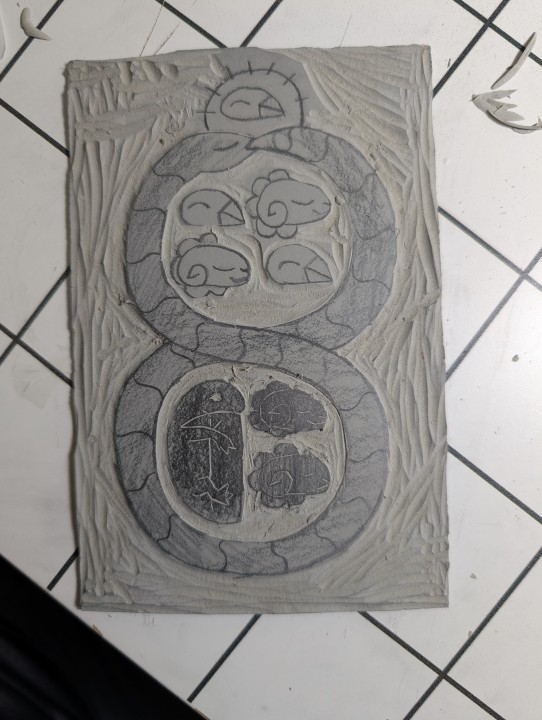
Linoleum
Linoleum is an organic flooring material made for linseed oil, pine resin, cork dust, sawdust, and some sort of mineral filler. True linoleum is thus biodegradable. The material should not be exposed to direct sunlight.
Linoleum can be heated to make it easier to work.
Rubber Block
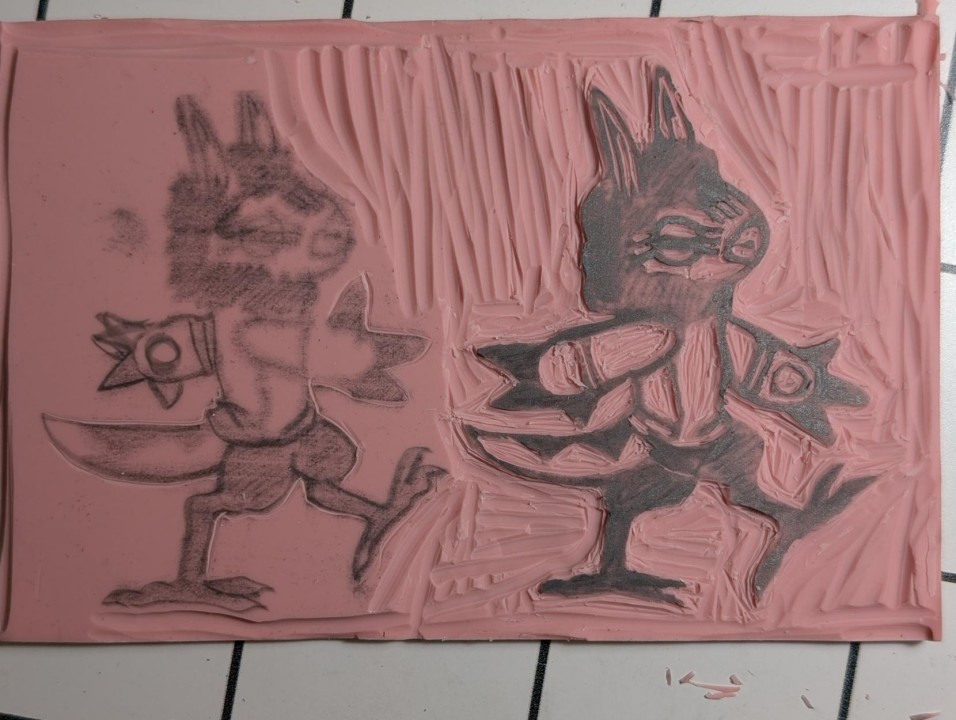
Some linocuts are made using "rubber blocks". Rubber blocks are easier to cut. However, some report that rubber blocks can dull your tools faster. Furthermore, rubber deforms more easily than linoleum. This makes getting fine details harder. Finally, rubber blocks are not made of biodegradable materials.
Transferring Drawings
Since the cut is placed either onto paper or paper placed onto it, the drawing must be constructed mirrored to the print. An easy way to handle this is using tracing paper. The unmirrored drawing can be traced with graphite. The resulting drawing can be placed graphite down onto the linoleum. Pressure is then applied to the tracing paper to transfer the graphite from the paper to the linoleum.
Cutters
A cutting tool provides a shape head able to dig into linoleum and remove material. cut-based print making is a subtractive medium. Negative space in the image must be carved away. Speedball sells a simple starter kit. This is what I own as it was cheep (enough) to to test if I actually wanted to commit. However, the speedball tool is prone to rusting. People report they are more intended to be "disposable" rather than a life long tool. Some searching confirms that blades are meant to be disposed of after going dull.
However, it is good enough for now. But, I will definitely be looking into more long term tools as I continue making prints. I definitely felt Speedball's cutter was not meant for proper linoleum. And I would rather work with linoleum over rubber block. Linocutting produces a lot of shaving, and I'd rather not produce instant microplastic evertime I make a cut.